How Long Does Bottled Water Last? Shelf Life and Storage Rules
Short answer
Unopened, commercially bottled water has no safety expiration: the FDA sets no shelf-life limit when it is stored properly, though taste can decline. Water you fill yourself is different, and the CDC says to replace it every 6 months.
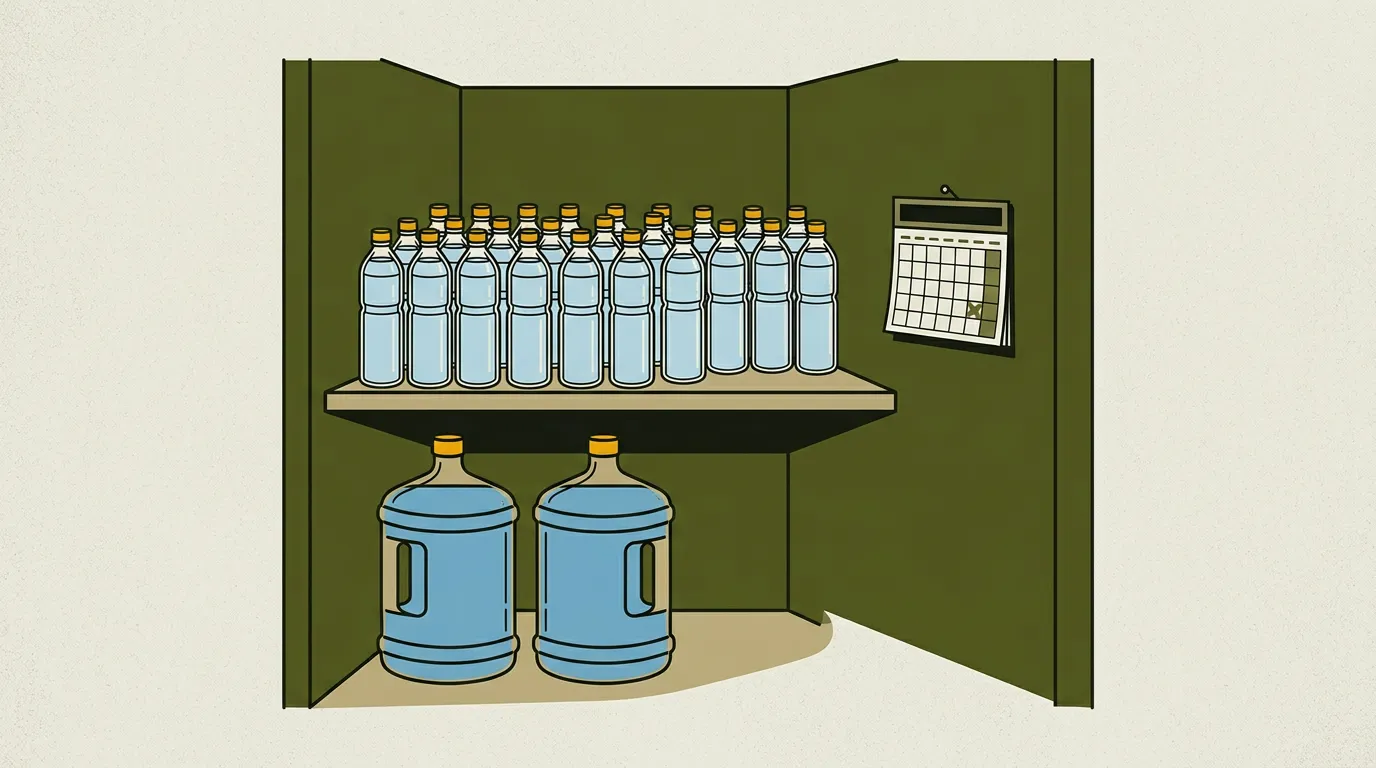
Two kinds of stored water, two different answers
Most confusion on this topic comes from mixing up two things.
| Store-bought, sealed | Filled at home | |
|---|---|---|
| Safe for how long | No set limit if stored properly | Replace every 6 months |
| Who says so | FDA position; CDC says to observe the date on the bottle | CDC |
| Main risk | Heat, sunlight, damaged seal | Unclean container, contamination at filling |
| Best container | The original sealed bottle | Food-grade water container with a tight cap |
The CDC calls unopened, commercially bottled water “the safest and most reliable source of water in an emergency”. That is the baseline to build on.
What the date on the bottle means
The FDA does not require an expiration date on bottled water. Its position is that bottled water produced under proper manufacturing practice and kept sealed has an indefinite safety shelf life. The agency also notes that long storage can cause off-odors and off-tastes.
So the date you see is mostly a stock-rotation mark. The CDC’s practical advice is simple: for store-bought water, observe the date on the label, and rotate your supply so the oldest gets used first.
Storage rules that decide how long it really lasts
- Cool. A closet, a basement, under a bed. Not next to a furnace or a water heater.
- Dark. Sunlight degrades plastic and encourages algae in anything that is not sealed.
- Away from chemicals. Plastic is slightly permeable to vapors. Do not store water next to gasoline, paint thinner or pesticides.
- Off bare concrete in a hot garage. If the garage reaches summer temperatures, your water is not being stored properly, whatever the date says.
- Sealed. Once a bottle is opened, treat it like any drink: refrigerate it and finish it within days.
Water you store yourself
Filling your own containers costs almost nothing, and it is how most households reach a real two-week supply. The CDC’s method:
- Use food-grade water storage containers. Do not reuse containers that held milk or juice: residues are hard to remove and feed bacteria.
- Wash the container with dish soap, rinse, then sanitize it with a weak solution of unscented household bleach, following the proportions on the CDC page linked below. Rinse again.
- Fill from the tap, close tightly, and label with the date.
- Replace every 6 months.
How much to store
The planning figure used by the CDC and the Red Cross is 1 gallon per person per day, for drinking and basic hygiene. Store at least 3 days, and aim for 2 weeks at home.
| Household | 3 days | 2 weeks |
|---|---|---|
| 1 person | 3 gallons | 14 gallons |
| 2 people | 6 gallons | 28 gallons |
| 4 people | 12 gallons | 56 gallons |
Fifty-six gallons weighs about 467 pounds. That is why a stored supply works best with a second layer: a way to treat water from a nearby source once the stored gallons are gone.
What we have not tested yet
We are running our own storage test, same water, three locations (closet, garage, car trunk), tasted and checked every month. We will publish the results here and date the update.
Common questions
Does bottled water expire?
Not in the safety sense, as long as the bottle is sealed and was stored away from heat and sunlight. The date printed on many bottles is used for stock rotation. Taste and smell can decline over time.
Can I drink bottled water left in a hot car or garage?
Heat and sunlight are the two things proper storage excludes. Water kept hot for months is not stored properly, and it often tastes of plastic. Keep your emergency supply indoors, and use the garage only if it stays cool.
How often should I replace water I stored myself?
Every 6 months, according to the CDC, using clean food-grade containers. Write the fill date on each container.
How much water should a family store?
The CDC and the Red Cross both use 1 gallon per person per day: at least 3 days, and 2 weeks if you can. For four people, 2 weeks is 56 gallons.